A higher NEMA number does not always mean more protection. That single misunderstanding is behind more misspecified control panels than any other factor: engineers see NEMA 12 and NEMA 4 side by side, assume the higher number wins, and end up with a dust-tight enclosure on a washdown line or a washdown-rated box on a dry factory floor where it never needed the added cost. NEMA enclosure ratings are not a scorecard. Each one defines protection against a specific set of environmental conditions, and the right rating depends on what your equipment actually faces, not which number looks more impressive on a spec sheet.
This guide breaks down the NEMA enclosure ratings you’ll actually specify for industrial and process equipment, in the order you’re likely to run into them on a plant floor, plus how NEMA relates to IP ratings and where hazardous-location enclosures fit in.
What NEMA Enclosure Ratings Actually Measure
NEMA, the National Electrical Manufacturers Association, publishes the enclosure classification system most commonly referenced in North American electrical and controls work: NEMA 250. Each rating in that standard defines what an enclosure protects against, drawing on tests for water ingress, dust ingress, corrosion resistance, and ice formation, among other conditions.
Because the classifications are additive rather than sequential, a NEMA 4X enclosure isn’t simply “more” than a NEMA 12 enclosure. NEMA 12 is built to keep dust and light oil spray out of an enclosure on an indoor factory floor. NEMA 4X is built to survive direct washdown and resist corrosion. They’re suited to different environments, not different tiers of the same environment. Specifying the wrong one either under-protects the equipment inside or adds cost and complexity a facility doesn’t need.
The NEMA Ratings You’ll Actually Specify
Most industrial and process facilities will only ever need to specify a handful of NEMA ratings. Here’s what each one covers, in order of how often they show up on a typical plant floor.
NEMA 1: Clean, Indoor Environments
NEMA 1 enclosures are built for indoor use in areas with no unusual environmental exposure: office-adjacent equipment rooms, clean assembly areas, and control rooms with climate control. They protect personnel from incidental contact with live components and keep out dust and dirt under normal indoor conditions, but they aren’t built for washdown, standing liquid, or heavy airborne particulate.
NEMA 12: Dust and Oil on the Factory Floor
NEMA 12 is the workhorse rating for general industrial floors. It’s designed to exclude dust, dirt, and non-corrosive light oil spray or coolant, which makes it the standard choice for control panels near CNC machining centers, conveyor lines, and other equipment that throws off fine particulate without a washdown requirement. If your panel lives on the production floor but never gets hosed down, NEMA 12 is usually the right call.
NEMA 3R: Outdoor, Rain and Snow
NEMA 3R covers outdoor installations exposed to rain, sleet, and snow. It’s common on exterior disconnects, rooftop equipment enclosures, and outdoor junction boxes where the panel needs weather protection but isn’t subject to submersion or direct spray washdown.
NEMA 4: Washdown
NEMA 4 steps up to indoor or outdoor washdown protection: hose-directed water, splashing, and, depending on the enclosure material, some resistance to corrosion. It’s the baseline rating for equipment that gets cleaned with a hose or pressure washer as part of a regular sanitation routine, but doesn’t need the added corrosion resistance NEMA 4X provides.
NEMA 4X: Washdown Plus Corrosion Resistance
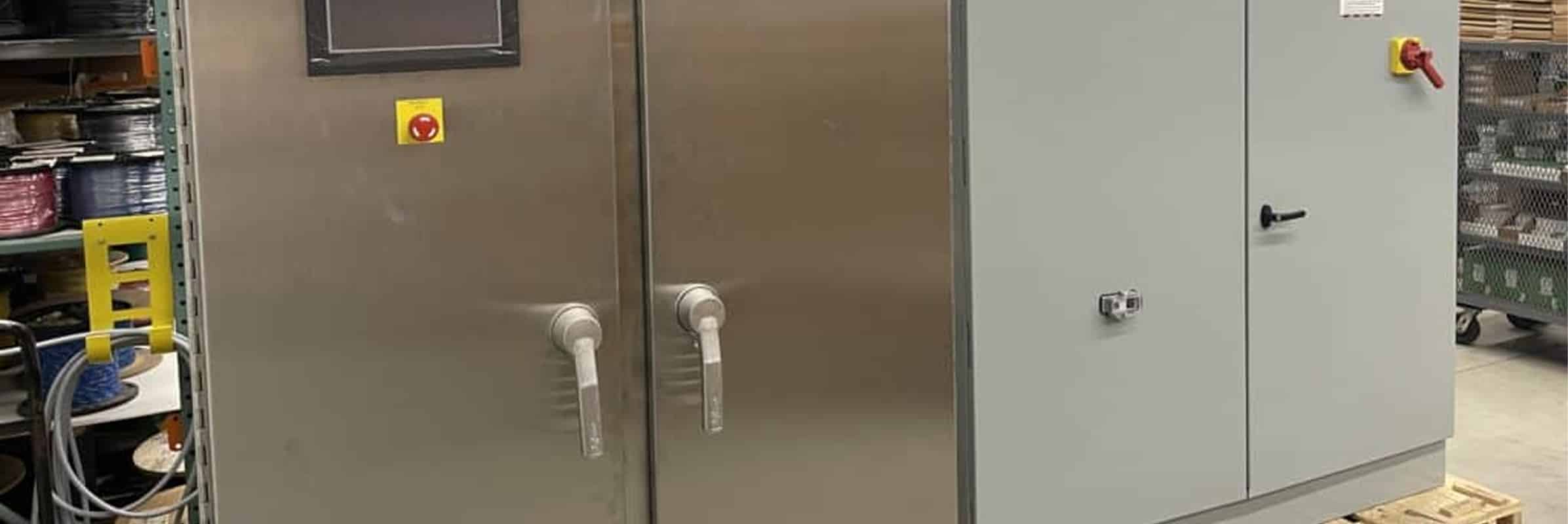
NEMA 4X carries everything NEMA 4 covers, plus additional corrosion resistance. That makes it the standard specification for food and beverage processing environments, where daily washdown and sanitizing chemicals both come into play, and for coastal or chemically aggressive settings in building materials production, where airborne moisture, dust, and process chemicals all accelerate corrosion over time. Stainless steel is the typical enclosure material for NEMA 4X applications, since it holds up to both the washdown cycle and the sanitizing agents without degrading.
NEMA 7 Through NEMA 10: Hazardous Locations
NEMA 7 through NEMA 10 cover hazardous, classified locations rather than general environmental exposure: NEMA 7 and 8 address Class I locations with flammable gases or vapors, NEMA 9 addresses Class II locations with combustible dust, and NEMA 10 covers specific mining applications. These are a narrower, more specialized category than the ratings above, and a facility working with flammable or combustible materials should treat hazardous-location classification as its own specification exercise rather than an extension of a standard NEMA rating.
NEMA Enclosure Ratings Chart
| NEMA Rating | Typical Environment | Protects Against |
|---|---|---|
| NEMA 1 | Indoor, clean, climate-controlled | Incidental contact, normal indoor dust |
| NEMA 12 | Indoor industrial floor | Dust, dirt, non-corrosive oil or coolant spray |
| NEMA 3R | Outdoor | Rain, sleet, snow |
| NEMA 4 | Indoor or outdoor washdown | Hose-directed water, splashing |
| NEMA 4X | Washdown plus corrosive exposure | Hose-directed water, splashing, corrosion |
| NEMA 7 / 8 | Hazardous, Class I locations | Flammable gases and vapors (explosion-related design) |
| NEMA 9 | Hazardous, Class II locations | Combustible dust (explosion-related design) |
| NEMA 10 | Specific mining applications | MSHA-defined hazards |
NEMA vs. IP Ratings: Related, Not Interchangeable
NEMA ratings and IP (Ingress Protection) ratings both describe what an enclosure keeps out, but they aren’t built on the same scale and don’t map one-to-one. IP ratings, defined under IEC 60529, describe ingress protection against solids and liquids using a two-digit code. NEMA ratings fold in additional criteria beyond ingress, including corrosion resistance, gasket aging, and construction requirements that IP testing doesn’t address. A NEMA 4X enclosure will typically meet or exceed IP66, but an IP66-rated enclosure hasn’t necessarily been tested or built to satisfy every NEMA 4X requirement. Where a project specification calls for NEMA 4X, an IP rating alone isn’t a like-for-like substitute.
Choosing the Right Enclosure for Your Application
The starting point for any enclosure specification is the environment the panel will actually sit in, not the highest-sounding rating available. A dry indoor floor doesn’t need NEMA 4X, and a daily washdown line can’t get by on NEMA 12. Where a facility’s layout, process, or space constraints don’t fit a standard enclosure, custom enclosure fabrication lets the enclosure get built around the actual application, including stainless steel construction for NEMA 4X requirements in food and beverage processing and other washdown-heavy environments.
South Shore Controls handles electrical panel design and build in-house, so enclosure selection, panel layout, and component integration happen under one process rather than being split across vendors.
Need Help Specifying the Right Enclosure?
Whether you’re scoping a single control panel or standardizing enclosure specs across a facility, South Shore Controls can help you match the right NEMA rating to the application before the equipment is built.
Contact our engineering team today to talk through your next panel build.
FAQs
Are NEMA ratings independently certified, or can a manufacturer self-declare them?
NEMA 250 allows a manufacturer to self-certify an enclosure against its published test criteria. Independent, third-party verification is also available through organizations like UL, which test and list enclosures against the same or related criteria. Where a project requires third-party certification rather than manufacturer self-certification, confirm that requirement up front, since it affects which enclosures and vendors qualify.
Do NEMA ratings apply to panels in hazardous (classified) locations?
Standard NEMA ratings like 1, 12, 3R, 4, and 4X address environmental ingress protection, not explosion protection. Panels in hazardous, classified locations need enclosures rated specifically for that classification, such as NEMA 7 through 10, along with any applicable UL hazardous-location listing and compliance with NEC Article 500. Treat hazardous-location specification as a separate requirement layered on top of, not replaced by, standard environmental protection.
Can I substitute an IP66-rated enclosure for a NEMA 4X requirement?
Not automatically. IP66 addresses dust and water ingress under IEC 60529, while NEMA 4X adds corrosion resistance and construction requirements that IP testing doesn’t evaluate. An enclosure can carry an IP66 rating without meeting every condition of NEMA 4X. Where a specification explicitly calls for NEMA 4X, confirm the enclosure has been tested and rated to that standard rather than relying on an IP rating as an equivalent.