The demand for smarter, more adaptable automation is reshaping how manufacturers approach their production lines. For many, the decision comes down to a fundamental question: cobots vs robots — which type of system is the right fit for your operation?
Both collaborative robots (cobots) and traditional industrial robots offer significant productivity gains, but they serve different roles. Cobots are designed for flexibility, ease of use, and direct human interaction. Industrial robots are built for power, speed, and scalability. Understanding the trade-offs between the two—and how each maps to your specific use case—is essential to making a smart investment.
Cobots and industrial robots are both valuable tools for modern manufacturing, but they excel in different environments.
- Cobots are ideal for high-mix, low-volume tasks where flexibility, ease of redeployment, and human-robot interaction are priorities.
- Industrial robots are better suited for high-speed, high-volume operations requiring precision, heavy payloads, and repeatability.
South Shore Controls works with manufacturers to simplify every step of robotic system integration—from application analysis and system design to safety compliance and post-installation support.
Talk to an Expert about your automation goals.
What’s the Difference Between a Cobot and an Industrial Robot?
The distinction between cobots and traditional robots lies in how they are designed to function within your workspace.
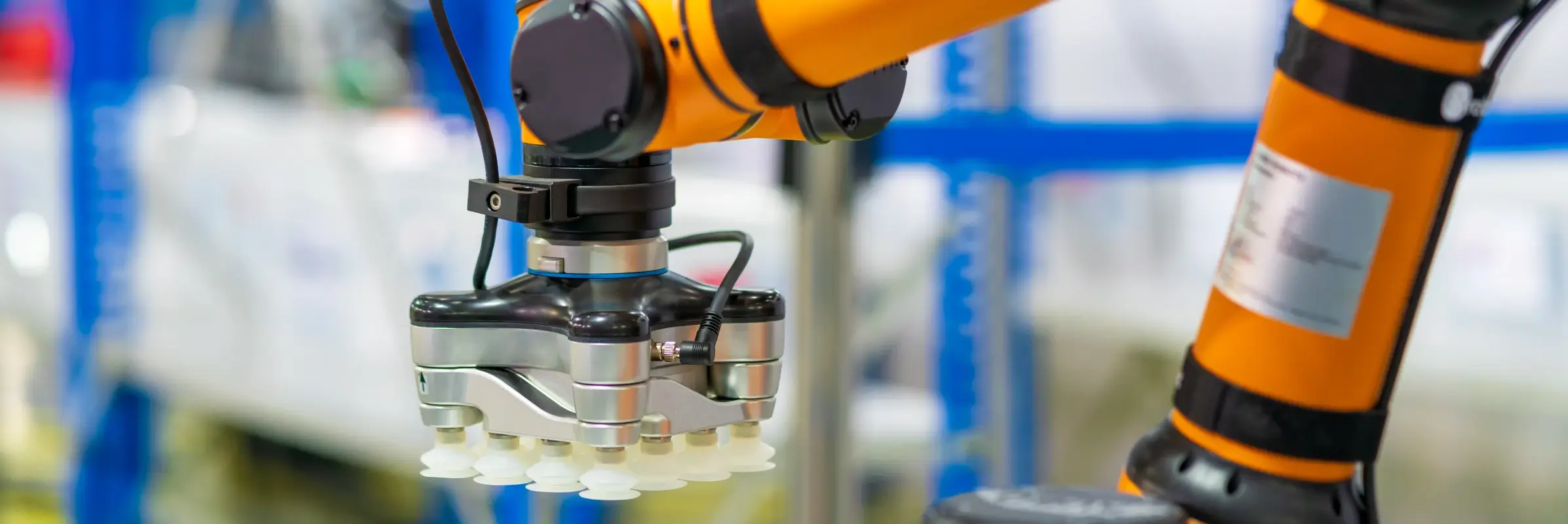
Collaborative robots are built to operate safely near human workers without requiring physical barriers or cages. With integrated force sensors, speed limitations, and intuitive programming, cobots make it easy to automate tasks like part loading, assembly, testing, and light material handling.
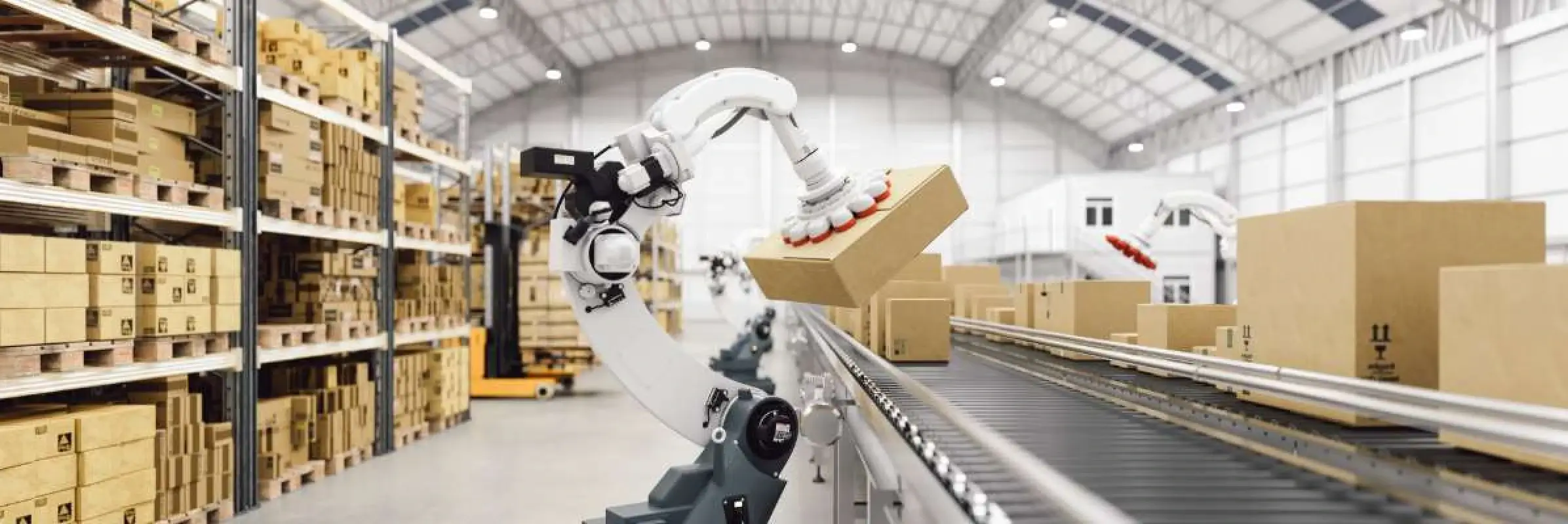
Industrial robots, by contrast, are typically enclosed within safety zones and optimized for speed, payload, and durability. They are a better fit for repetitive, high-throughput processes such as palletizing, welding, or heavy-duty pick-and-place operations.
Key areas of comparison include:
- Collaboration model: Cobots are inherently safe for human interaction; industrial robots require separation.
- Speed and throughput: Industrial robots are much faster but require guarding.
- Payload and reach: Industrial systems handle larger, heavier parts with extended reach.
- Programming and flexibility: Cobots are easier to teach and redeploy; industrial robots offer more control and customization but require skilled integration.
Capabilities and Trade-Offs: A Side-by-Side Comparison
Choosing between collaborative robots vs industrial robots depends on your performance needs, safety constraints, and long-term scalability. Here’s a quick breakdown:
| Feature | Cobots | Industrial Robots |
| Speed | Moderate (for safety) | High-speed cycles |
| Payload | Typically 5–20kg | 50kg–1000kg+ |
| Reach | Limited | Extensive, configurable |
| Precision | Suitable for many tasks | Extremely high for complex paths |
| Safety Approach | Built-in sensors; ISO/TS 15066 | Requires fencing/light curtains (ISO 10218) |
| Footprint | Compact, no cage | Larger, needs guarding |
| Programming | Hand-guided, user-friendly | Complex, code-based or teach pendant |
| Changeover | Fast, easy redeployment | Time-consuming, requires reprogramming |
| Applications | Machine tending, kitting, inspection | Welding, palletizing, heavy handling |
| Initial Cost | Lower | Higher |
| TCO | Lower in low-volume use | Higher but scalable |
| Best For | Agile, high-mix environments | High-speed, high-throughput processes |
Cobots shine in flexible roles. Industrial robots dominate where speed and payload capacity are essential.
Safety and Compliance: What You Need to Know
Safety is one of the most critical differentiators between cobots and industrial robots.
Cobots are designed with built-in safety features like torque sensing, speed limits, and force thresholds. They comply with ISO/TS 15066, which defines parameters for safe human-robot collaboration. This enables them to work in shared spaces without cages, as long as a risk assessment confirms safety thresholds are met.
Industrial robots, however, are governed by ISO 10218 and ANSI/RIA R15.06, which require perimeter guarding, interlocks, and light curtains. These systems achieve higher performance but introduce more complexity during integration.
South Shore Controls performs detailed robot risk assessments for every project, identifying hazards, defining performance levels (PLr), and specifying safety-rated components. For aerospace, defense, and other regulated sectors, we support full compliance with:
- AS9100: Aerospace quality standards
- ITAR: Export controls and defense compliance
- MIL-SPEC: U.S. military performance specifications
Our team ensures that every robotic system meets both safety and regulatory requirements—documented, validated, and audit-ready.
Robotic System Integration with South Shore Controls
Implementing robotic automation is more than choosing a machine. It’s about designing a complete, efficient workcell. As a turnkey robot integration partner, SSC manages every step:
Discovery and Application Fit
We evaluate part geometry, cycle time requirements, payload, EOAT needs, and floor space. This ensures your system selection is grounded in performance realities.
Custom Cell Design
Our in-house engineers design robotic workcells that include the right robot type, custom end-of-arm tooling, part presentation (fixtures, conveyors), and guarding based on your application and compliance needs.
Controls Engineering and Panels
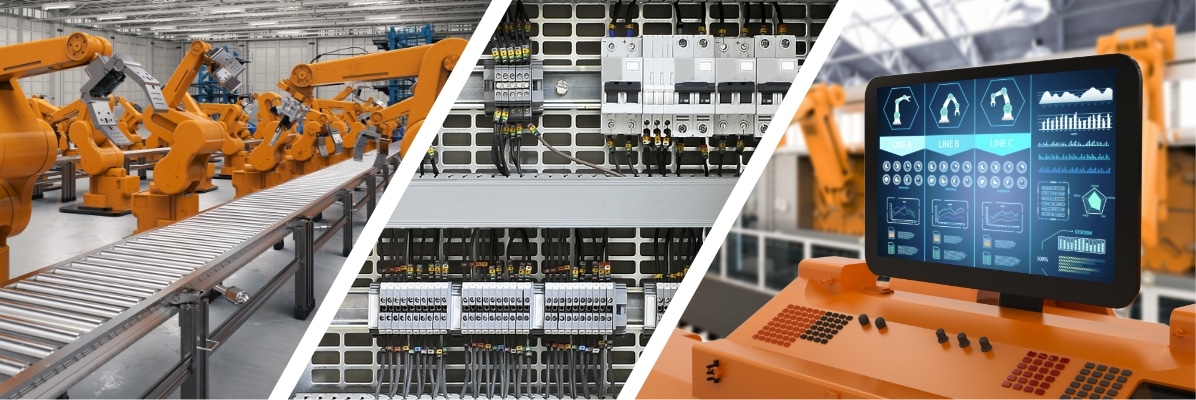
We build UL-listed custom control panels with PLC, HMI, and SCADA integration. Data collection and OEE reporting are available for real-time insights.
Build, Test, and Commissioning
SSC fabricates, tests, installs, and commissions each robotic cell with full FAT and SAT protocols. Training and handoff are included.
Lifecycle Support
Post-installation, we provide spare parts, remote support, preventive maintenance, and changeover engineering to extend the life of your system.
Learn more about robot integration and custom control panels.
Where Each Robot Type Fits Best
Choosing between cobots and industrial robots isn’t just technical—it’s about aligning automation with your goals, constraints, and product mix.
Cobots are ideal for:
- Machine tending with multiple SKUs
- Part kitting, testing, and inspection
- Manual processes that need ergonomic relief
- Assembly and fastening tasks
- Labs or high-mix manufacturing lines
Industrial robots are best when:
- Throughput and cycle time are top priorities
- Parts are heavy or need precise motion
- The process runs 24/7 with minimal changeover
- You need aggressive deposition rates (e.g., welding)
- Space for guarding is available
South Shore Controls brings experience in both, helping you map performance needs to the right automation path—now and as your volumes grow.
Cost, ROI, and Scalability
Upfront price isn’t the whole story. The total cost of ownership includes integration, training, support, and downtime avoided.
Cobots typically have lower startup costs, especially where guarding isn’t needed. They’re faster to install and easier to program, shortening ROI timelines. Industrial robots carry higher upfront cost, but their speed, accuracy, and uptime often justify the investment over time—especially in high-throughput environments.
SSC helps you build a phased automation roadmap, starting with a cobot pilot and scaling to a fully integrated robotic cell as your needs evolve. EOAT, sensors, and programming can often be reused, protecting your investment.
Request a Quote to get ROI projections tailored to your line.
FAQs
What is the difference between a cobot and an industrial robot?
Cobots are designed for safe, collaborative workspaces. Industrial robots are faster and more powerful but require separation and guarding.
When should I choose a cobot over a robot?
Choose a cobot for flexible, human-adjacent tasks. Go with an industrial robot for speed, payload, and repeatability.
Are cobots safe to work next to people?
Yes—when deployed in compliance with ISO/TS 15066 and after a full risk assessment. SSC handles safety documentation for all projects.
What’s included in a robot risk assessment?
Hazard identification, PLR target assignment, safety device selection, and validation. SSC manages the process and documentation.
Can SSC integrate multiple robot brands and custom EOAT?
Yes. We work with most major robot brands and develop application-specific tooling in-house.
Why South Shore Controls
South Shore Controls is a full-service automation integrator with in-house mechanical, electrical, and controls engineering teams. We design and deliver:
- Turnkey robot integration systems
- UL-listed custom control panels
- Specialty machinery and fixtures
- Contract manufacturing and build-to-print assemblies
- Safety compliance and lifecycle support
With deep experience in aerospace, defense, food/bev, industrial goods, and consumer products, we help manufacturers automate smarter—safely and sustainably.